
Review
EOS One Review (2026): Why Implementers I Interviewed Told Me They Warn Their Clients
Last updated May 30, 2026 · Written by Jeremy Chatelaine
Does EOS One live up to the official EOS® name it carries?
Summarize with ChatGPTSummary
EOS One has the advantage of official EOS® branding, but it seems like that's pretty much all it has going for it. The product falls far short as a modern operating platform.
Introduction
As the branded software built by the organization behind EOS, we expected nothing but the best. But while the book Traction has a solid 4.6 out of 5 rating on Amazon, EOS One clearly fails to deliver when it comes to the digital world.
During my interviews with EOS® implementers, I asked which tool they recommended to their clients. The typical response was that they let their clients choose whatever they wanted… as long as it wasn't EOS One.
That wasn't very encouraging, but we decided to do a thorough review and see for ourselves nonetheless.
So, based on our deep dive into EOS One and our exhaustive analysis of user sentiment across the web, here is our definitive 2026 review of EOS One.
What is EOS One?
EOS One is the proprietary software platform developed by EOS Worldwide to help businesses run on the Entrepreneurial Operating System.
For the uninitiated, EOS® is a set of simple, practical tools used by more than 190,000 companies worldwide to achieve "Vision, Traction, and Healthy."
Historically, EOS Worldwide licensed its intellectual property to third-party software providers such as Ninety.io and Bloom Growth (formerly Traction Tools).
In a move to own the "pure" user experience, EOS Worldwide launched EOS One. It was designed to serve as the digital home for your Vision/Traction Organizer (V/TO), Accountability Chart, Level 10 Meetings™, and Scorecard.
The Origin Story
For years, teams complained that third-party tools felt like "add-ons." They were often clunky, lacked the official terminology, or felt like generic project management software trying to fit EOS®.
EOS One was launched to address that. By building the software in-house, EOS Worldwide intended to create a platform that evolves at the same speed as the methodology itself.
It made perfect sense, but what they didn't quite grasp at the time is that building software of this magnitude requires serious product development expertise.
The Hype vs. The Reality
EOS® is a phenomenal business framework. It has helped tens of thousands of entrepreneurs gain clarity with their vision and build healthy leadership teams. The system itself is considered the gold standard for the market it serves.
Because of this immense brand equity, the launch of EOS One came with an automatic user base. People trusted the EOS® name. The pitch was perfect: why use a third-party tool when you can use the official platform designed by the people who literally wrote the book on Traction?
However, online reviews and community forums quickly began reflecting deep frustration with the platform. Users reported that it feels extremely slow, clunky, outdated, and rigid.
Creating good software naturally requires a different set of skills.
Consequently, the day-to-day experience of using EOS One feels very far from the sleek, modern operational software that has become the norm in today's software landscape.
Instead of empowering fast-moving businesses, it often feels like a tool that forces teams to conform to poorly designed workflows in the software.
Who Is Actually Using EOS One?
Before diving into the specific features and the brutal realities of the software, let's look at who makes up the EOS One user base in 2026. Based on market analysis and online sentiment, users generally fall into two categories:
- The Brand Loyalists: These are companies whose leadership teams are so deeply committed to the EOS® methodology that they will use whatever tool bears the official logo. They end up tolerating the bugs and the clunky interface because they value the official branding over operational efficiency.
- The Uninformed Self-Implementers: These are businesses newly adopting EOS®. They read the book and want the real EOS® experience, and worry that using another system will somehow make them diverge from "proper" EOS®. Often, these users haven't experienced modern, high-performance operational software. In the end, they may even end up throwing the baby out with the bathwater, abandoning EOS® entirely because of their poor experience with the software.
If your company is a fast-paced, high-growth environment filled with digital natives, you will almost immediately recognize that EOS One was not built for you.
The Core Features: A Deep Dive into the "Six Key Components"
Let's break down the core features of EOS One, examining how their intended design holds up in real-world use.
The Vision/Traction Organizer (V/TO)
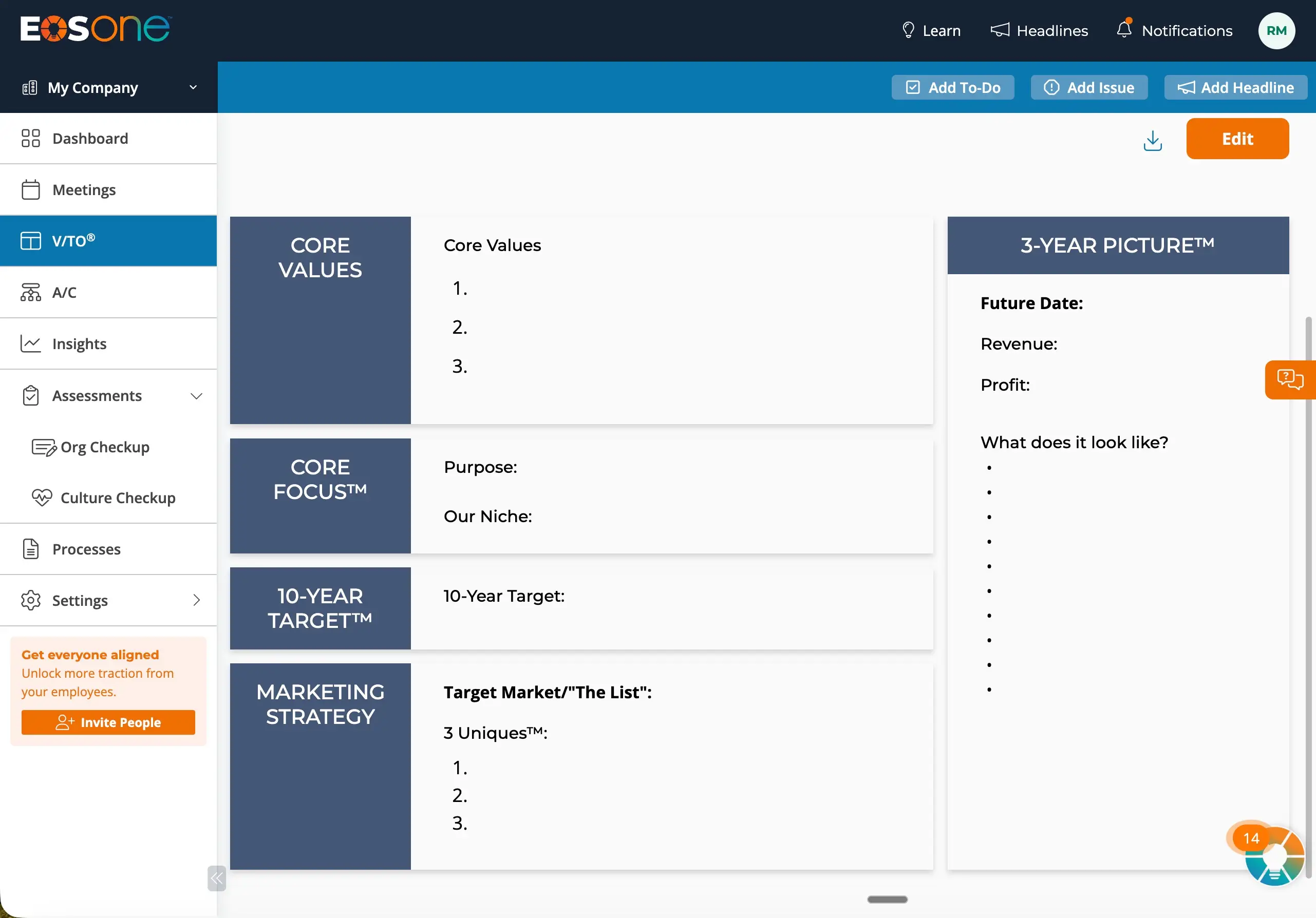
The Vision/Traction Organizer is the heartbeat of any business running EOS®. It's where your Core Values, Core Focus, 10-Year Target, Marketing Strategy, 3-Year Picture, 1-Year Plan, and quarterly Rocks live.
EOS One successfully digitizes the V/TO, moving it out of a static PDF and into the cloud. You can fill out the sections, and it uses the exact trademarked terminology you expect. However, it feels remarkably disconnected from the rest of the software and might as well just be a link to a PDF.
A modern business operating system should have a dynamic V/TO, where a 1-Year Plan goal automatically cascades into a departmental Rock, which then links to weekly to-dos.
In EOS One, the V/TO often feels like a series of static text boxes. When you update a goal, you still have to manually ensure it's reflected elsewhere. It lacks the relational database architecture that makes modern software so powerful.
You are essentially typing into a digital PDF, which defeats the purpose of paying for software in the first place.
Data & Scorecards
The Scorecard is designed to give leadership teams a pulse on the business through a handful of weekly measurable numbers. The software allows you to create a scorecard, assign measurables to specific owners, and set weekly goals, automatically aggregating this data so it can be reviewed during your Level 10 meetings.
One would expect some level of data entry automation in this day and age, which turns out to be a major complaint. EOS One lacks an open API and native integrations with other tools.
On top of that, manipulating the data, changing date ranges, or trying to view historical trends is a frustratingly slow experience that lacks the snappy, real-time feel of a modern analytics dashboard.
Meetings (Level 10)
The Level 10 Meeting is the most important component, where leadership teams review their scorecards, check on Rocks, share customer and employee headlines, and IDS (Identify, Discuss, Solve) their issues. Since users spend the bulk of their time here, this feature needs to be flawless.
The platform walks you through the standard Level 10 agenda, complete with a timer and unified views of your Scorecard, Rocks, and Issues List. Unfortunately, this is where the poor execution of EOS One becomes most painful.
While a step-by-step interface may feel helpful for a first meeting, the click-intensive and slow navigation quickly becomes a hindrance.
Instead of facilitating smooth discussions, it often creates unnecessary friction and frustration among participants.
What EOS One Does Well: The Pros
To be completely fair in this EOS One review, we must acknowledge that the platform actually does a few things right.
1. High Fidelity to the Methodology
Because EOS One is built by EOS Worldwide, there is zero "translation error." The language, the flow, and the logic of the software match the books Traction and What the Heck Is EOS? perfectly. For teams that want to run EOS® "by the book," this is the gold standard. There are no confusing features or unnecessary additions that fall outside the framework.
2. The "First User Free" Pricing Strategy
EOS One allows you to start for free with your first user. This is ideal for a Visionary or Integrator who wants to explore the software and set up the V/TO and Accountability Chart before inviting the rest of the leadership team.
If you are willing to share logins and use observers, you may even be able to get your whole team on it for free.
3. Framework Enforcement
If you are a company that struggles with discipline and wants software that acts as a strict taskmaster, EOS One will force you into the exact rhythm of the system. It does not allow much deviation, which for a very specific type of struggling business might be exactly what's needed to build initial discipline, assuming you are willing to enforce its use.
What EOS One Doesn't Do Well: The Cons
Unfortunately, the frustration and struggles reported by EOS One users are very real.
The fundamental problem is that EOS Worldwide is a franchise of business coaches, an intellectual property company, and a publishing house. Building enterprise-grade, highly responsive, deeply integrated business software requires specific skills that they don't seem to possess.
EOS One feels exactly like what it is: software designed by a committee of business coaches.
1. Terrible UI/UX
The user interface feels like it was designed a decade ago. It relies heavily on modal windows, slow page refreshes, and an excessive number of clicks to accomplish basic tasks.
Even worse, it hasn't changed much over time and doesn't appear to be evolving either.
In an era where consumer and enterprise software is fluid, real-time, and frictionless, using EOS One feels like walking through digital mud. It is not intuitive.
Onboarding new employees often requires actual training on how to use the tool, rather than the software naturally guiding users through the workflow.
Adoption, especially among younger executives, will likely be a serious challenge.
2. No Open API or Meaningful Integrations
In 2026, a business application that cannot communicate with the rest of your tech stack is a serious handicap. The lack of an open API means your company's data is siloed and trapped.
You cannot automate your Scorecard from your ERP. You cannot link your engineering team's Jira tickets to their EOS Rocks. You cannot pull HR data into the Accountability Chart.
EOS One demands that it be the center of your operational universe, but it doesn't build the bridges necessary to actually live there.
3. A Complete Lack of Innovation
While the rest of the software world keeps innovating, EOS One has shown little sign of progress in years.
As companies everywhere explore how AI can make leadership easier and more effective, EOS One remains completely silent on the subject. Adding meaningful AI capabilities requires serious engineering expertise, and this may well be beyond the current capabilities of the EOS One development team.
It also goes against their main business (network of coaches), so they may not be eager to let AI assist businesses too quickly.
In many ways, EOS One has never moved beyond being a digital version of pen-and-paper forms.
4. Implementer Backlash
Perhaps the most damning indictment of EOS One comes from inside the house. Many certified EOS® Implementers I interviewed told me they warn their clients to stay away from the tool.
They see firsthand how the software frustrates leadership teams. An implementer's goal is to remove friction so leadership teams can focus on running their business.
When the software itself becomes the source of friction, the implementer has no choice but to step in.
The Limitations: Why This Matters for Your Business
Using poor software is not just an annoyance; it undermines the efforts you are taking to improve your business. It's a hidden tax on your company's productivity and a serious implementation risk for EOS®.
When you choose EOS One, you are choosing a system with significant limitations that restrict your ability to automate and move quickly. You will likely face serious adoption challenges, as your team will naturally avoid using a clunky tool.
A business operating system should be a competitive advantage. It should make your team faster, more aligned, and give you better visibility into the business.
EOS One, through its rigidity and poor technical architecture, does the exact opposite. It slows you down with administrative overhead. You end up serving the software rather than the software serving you.
When to Consider Alternatives
For the vast majority of businesses, especially those that view technology as a lever for growth, it may be wise to consider alternatives.
You are a digital-native company or a company in high-growth mode: Your team uses Slack, Notion, Asana, and modern CRMs. They will revolt if forced to use a clunky, legacy-feeling tool.
You value automation: You want your scorecards to update themselves through API connections to your actual data sources.
You want a fast, snappy user experience: You expect your Level 10 meetings to run flawlessly without waiting for tabs to load.
You want intelligent assistance: You expect modern software to include AI features that save your team time.
The system (EOS®) is great. The tool (EOS One) is unfortunately not its digital equivalent.
Conclusion: Lucky to Have the Name
EOS One is about as close as you can get to turning a really good framework into a frustrating online experience.
It's like those terrible video games that rely on a beloved franchise to drive sales.
They had the audience, the methodology, and the brand loyalty.
All they had to do was build great software.
But they fundamentally misunderstood what it takes to build great software. It takes more than a good methodology, and the company did not have the engineering talent required to build software worthy of the framework.
Combine that with the painfully slow pace of improvements to the software, and you may end up wishing your competitors chose this tool to slow themselves down.
Do not let brand loyalty blind your judgment. Your leadership team's time is far too valuable to be spent fighting poorly built software during your most important weekly meetings.
How MonsterOps Compares
To some extent, MonsterOps can be seen as the complete opposite.
MonsterOps is not officially endorsed by or affiliated with EOS Worldwide. But many companies running on EOS® use it successfully.

Braden
“We’ve been using EOS in our business for a number of years but had struggled to find a reliable, cost effective, and user friendly EOS implementation tool online. I stumbled across MonsterOps and couldn’t be happier that I did! Its functionality is equal or better than some of the other software we’ve used but at a fraction of the cost.”
It was built by a true software company with decades of engineering experience across multiple large-scale businesses, combined with deep expertise in user experience design. The team is passionate about building efficient business operating systems and serving your business.
MonsterOps understands that you don't just need a digital checklist; you need a high-performance engine that drives visibility, accountability, and results without adding complexity.
It leverages AI and doesn't feel compelled to stick to EOS® in a rigid way and allows room for teams to run their own show as their understanding of EOS®, and what makes it successful for their company, evolves.
| Feature | EOS One (The branded choice) | MonsterOps (The modern OS) |
|---|---|---|
| EOS® | Perfect adherence to terminology | Flexibility, adapts to your business needs |
| User Experience | Static & Clunky. Relies on slow page refreshes, rigid text boxes, and feels like a web app built a decade ago by non-developers. | Real-Time & Snappy. Built on a modern tech stack with low latency and a "fluid" collaborative feel that digital natives love. |
| Connectivity | Black box. As of the time of writing, there is no open API. It refuses to connect easily with the rest of your tech stack, forcing endless manual data entry. | Open Ecosystem. Open API ready for the agentic era, and native Zapier integration to connect your workflows to all your existing tools. |
| Innovation | Not much. A basic digital filing cabinet. No innovation, no AI, no smart features to help your team work faster. Trapped in the past. | Rapid innovator. Instantly adopts the latest state-of-the-art improvements, regardless of the framework, for your benefit. |
| Engineering DNA | A coaching franchise requires different skills than a software company. We can see fundamental problems with architecture and UI decisions. | Built by Experienced Engineers and passionate operators. A true software company dedicated to building the best software possible for businesses of all sizes. |
When you spend your time looking at meaningful reports rather than battling to create to-dos and issues, and your team willingly uses the software without you having to chase them, you know you made the right choice.
Cost calculator: MonsterOps vs EOS One
Based on official EOS One pricing: first user is free, each additional user is $10/month, billed monthly with no contract.
MonsterOps
$129/mo
$129/mo month-to-month with unlimited users.EOS One
$240/mo
First user free. $10 x 24 additional users, billed monthly, no contract.Meet MonsterOps
MonsterOps is built for founders who want a faster, more automated operating system without the drag of legacy tools.